How to Use Construction Toys to Teach STEM and Real-World Skills (Ages 6–12)
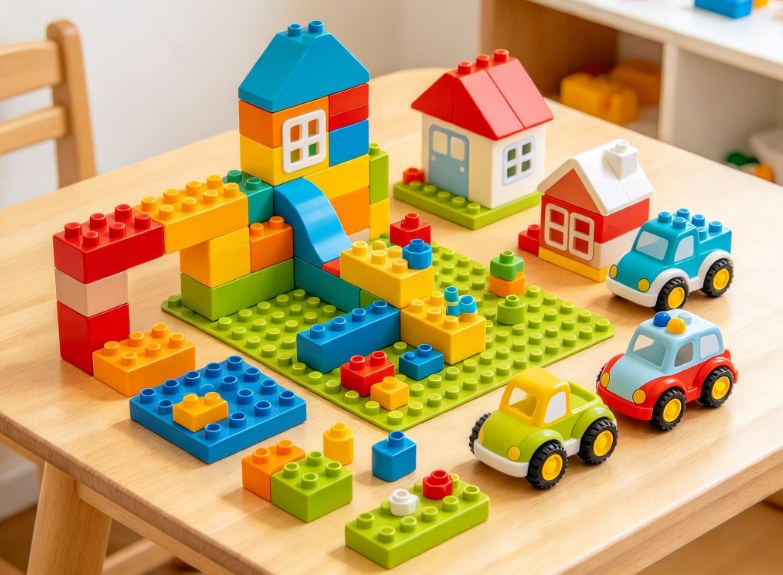
A 9-year-old builds a bridge between two chairs. She sets a juice box on top. The bridge folds in the middle.
She doesn't quit. She looks at the break, adds a row of bricks underneath, and tries again. It holds. Then she tries two juice boxes.
That's engineering. Nobody called it a lesson, and nobody had to.
Construction toys are one of the most practical STEM tools you can bring into a home or classroom. Kids aged 6 to 12 are old enough to follow a plan, test an idea, and explain why something failed. They are also young enough to treat all of it like play.
This guide shows parents and educators how to turn bricks into real skills. You'll get:
- A simple design process kids can use on any build
- Math, physics, and coding activities that use standard bricks
- A side-by-side look at classroom and home use
- Ways to connect builds to real jobs and real problems
- A quick-win checklist to start this week
What Kids Learn at Each Age
Start here. Skills build on each other, so match the activity to the stage.
| Age | What They're Ready For | STEM Focus | Sample Challenge |
| --------- | ------------------------------------------------------- | ----------------------------------------- | -------------------------------------------------- |
| 6–7 | Following picture steps, counting, simple sorting | Patterns, counting, basic shapes | Build a wall using a repeating color pattern |
| 8–9 | Planning before building, measuring, cause and effect | Measurement, forces, wheels and axles | Build a bridge that holds 20 coins |
| 10–12 | Multi-step plans, testing variables, explaining results | Gear ratios, structures, algorithms, data | Build a crane that lifts a cup and log the results |
These ranges aren't strict. A curious 7-year-old can handle gears. A 12-year-old new to building can start with patterns. Meet the child where they are.
---
Step 1: Teach the Design Loop Before the First Build
Engineers don't build once. They build, test, and fix. Kids should learn that loop early.
The engineering design process taught in many US and UK schools follows six stages. Here's how each one looks at a build table:
| Stage | What the Kid Does | What You Say |
| ----------- | ---------------------------- | -------------------------------------------- |
| Ask | Defines the problem | "What does it need to do?" |
| Imagine | Lists 2–3 ideas | "What are three ways to try it?" |
| Plan | Sketches one idea | "Draw it first. Use graph paper." |
| Build | Assembles the model | "Build your plan. Change it if you need to." |
| Test | Runs a fair test | "Did it work? How do you know?" |
| Improve | Fixes one thing, tests again | "What's one change that would help?" |
Why the Loop Matters
Most kids see failure as the end. The loop makes it the middle. A collapsed tower isn't a mistake. It's test data.
TRY THIS: Print the six stages on a card. Tape it to the build table. Point to the stage your child is in during every challenge. After three or four builds, they'll start naming the stages themselves.
Keep Plans Simple
A plan doesn't need to be perfect. For ages 6 to 8, a rough drawing with labels is enough. Ages 9 to 12 can use graph paper where one square equals one stud. That one habit teaches scale, planning, and spatial reasoning at once.
---
Step 2: Pick Sets by STEM Skill, Not Just Theme
Kids choose sets by what looks cool. That's fine. But some construction building blocks teach more than others, depending on the parts inside.
Use this table to match parts to skills:
| STEM Skill | Parts to Look For | Real-World Link | Good Starter Challenge |
| -------------- | --------------------------------------- | ---------------------------- | ----------------------------------------- |
| Structures | Long bricks, plates, beams, base plates | Bridges, skyscrapers, homes | Tallest free-standing tower in 10 minutes |
| Motion | Wheels, axles, turntables | Cars, trains, conveyor belts | Vehicle that rolls straight for 2 meters |
| Mechanics | Gears, cranks, pulleys, hinges | Cranes, clocks, bike gears | Crank that lifts a small load |
| Math | Basic bricks in 3–4 colors | Fractions, area, symmetry | Show 1/2, 1/4, and 1/8 with bricks |
| Design | Mixed parts, figures, slopes, tiles | Product design, architecture | Design a playground for figures |
The Best Mix for Ages 6–12
A strong STEM collection combines three things:
- A basic parts bucket. Bricks and plates for math and structure activities.
- One mechanical set. Gears, axles, and a crank for simple machine challenges.
- One larger model with detailed instructions. Following a complex build teaches sequence, focus, and precision.
Instruction-led sets and free builds work together. The instructions teach techniques. The challenges teach kids to use them.
Explore STEM-friendly building sets at Morebybourn to find mechanical kits, vehicles, and structure-heavy builds for school-age kids.
---
Step 3: Use Bricks to Make Math Visible
Math gets hard when it stays on paper. Bricks make it physical. A child who can hold a fraction understands it faster.
Fractions
A standard 2x4 brick has 8 studs. That makes it a perfect fraction tool.
- A 2x2 brick is half of a 2x4.
- A 1x2 brick is a quarter.
- A 1x1 brick is one-eighth.
Ask your child to cover a 2x4 brick using only 1x2 bricks. How many fit? Four. So each is one-quarter. Now try mixing sizes to make a whole.
Multiplication and Arrays
A 2x4 brick is literally a multiplication problem: 2 rows of 4 studs. Ask kids to find bricks that show 2 x 3, 1 x 6, or 4 x 4. Then flip the brick and show that 2 x 4 equals 4 x 2.
Area and Perimeter
Build a rectangular "garden" on a base plate. Count the studs inside for area. Count the studs around the edge for perimeter. Then ask the tricky question: "Can you build a garden with the same area but a bigger perimeter?" Kids figure it out by moving bricks, not by memorizing a formula.
Measuring in Real Units
One stud measures 8 millimeters from center to center. A 10-stud line is about 8 centimeters. Have kids measure a model in studs, then convert to centimeters. It's a natural intro to unit conversion, and it connects to the metric system used across Europe and in science classrooms everywhere.
Symmetry
Build half a butterfly, house, or robot. Hand it to your child and ask them to build the mirror half. This trains visual thinking. It's the same skill used in design, architecture, and geometry.
QUICK WIN: Keep a "math tray" of 40 basic bricks in four colors. Pull it out during homework time when a concept isn't clicking.
---
Step 4: Test Forces and Structures Like a Real Engineer
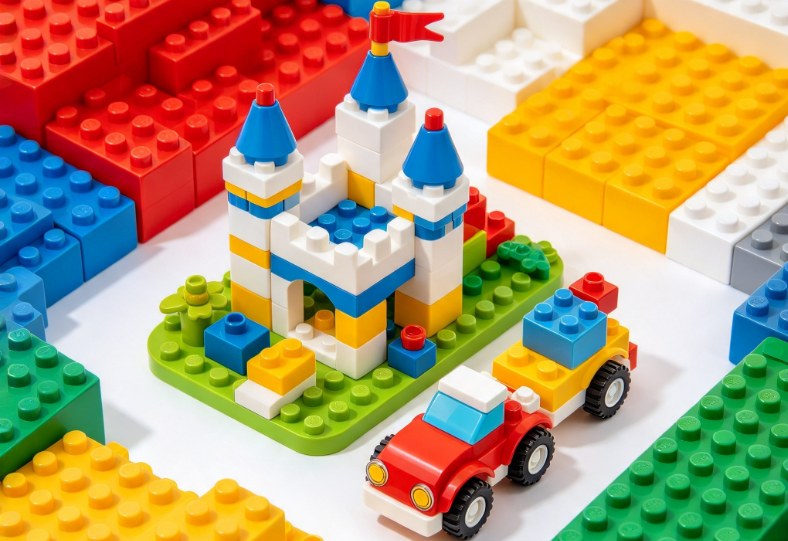
Physics clicks when kids see it fail. Building toys let them break things safely and rebuild in minutes.
The Coin Bridge Challenge
Goal: Build a bridge that spans a 20 cm gap between two books and holds the most coins.
- Set two books 20 cm apart.
- Build a bridge using no more than 50 pieces.
- Place coins in the center, one at a time.
- Count how many it holds before it bends or breaks.
- Change one thing and test again.
Kids discover two key rules fast. Thicker beams hold more. Overlapping bricks hold more than stacked columns. That overlap pattern is called a running bond. Bricklayers use it on real walls for the same reason.
The Shake Table Test
Earthquake engineers test buildings on shaking platforms. You can make a simple version.
- Place a base plate on a tray.
- Set the tray on four tennis balls.
- Build a tower on the plate.
- Gently slide the tray back and forth for 10 seconds.
Which towers survive? Usually the ones with wide bases and diagonal supports. Ask kids to add cross-bracing, then test again. They're learning why triangles show up in cranes, bridges, and roof frames.
The Wind Test
Use a desk fan or a hair dryer on the cool setting. Point it at a tower from 50 cm away. Kids test shape, height, and weight. A tall, narrow tower falls first. A wider, lower one holds. That's the same thinking behind skyscraper design.
SAFETY NOTE: An adult should handle the hair dryer. Keep standard bricks away from children under 3, especially during tests where pieces scatter.
Keep a Test Log
For ages 9 to 12, add a simple results table:
| Test # | What I Changed | Result | What I Learned |
| ------ | --------------------- | ------------- | ------------------- |
| 1 | Nothing (first build) | Held 8 coins | Middle bent first |
| 2 | Added a second layer | Held 15 coins | Thicker is stronger |
| 3 | Added side walls | Held 26 coins | Walls stop bending |
Writing it down turns play into a science report. Teachers love this format.
---
Step 5: Build the Six Simple Machines
Every complex machine is built from a few simple ones. Kids who build these understand how the world moves.
| Simple Machine | How to Build It With Bricks | Real-World Example |
| ------------------ | ---------------------------------------------------------------- | ------------------------------------ |
| Lever | A long beam balanced on a single brick (the fulcrum) | Seesaw, crowbar, bottle opener |
| Wheel and axle | Two wheels on a rod, attached to a base | Car, doorknob, rolling cart |
| Pulley | A wheel on a raised frame with string over it | Flagpole, elevator, window blinds |
| Inclined plane | A ramp made from plates on a slope | Wheelchair ramp, slide, loading dock |
| Wedge | Two slopes joined at a point | Axe, doorstop, knife |
| Screw | Harder with bricks; show with a spiral of plates around a column | Jar lid, drill, spiral staircase |
Gears: The Big Lesson for Ages 10–12
Gears are where kids get their first taste of real mechanical engineering.
Try this with any set that includes gears:
- Connect a small gear (8 teeth) to a large gear (24 teeth).
- Turn the small gear 3 full times. Count how many times the large gear turns. One time.
- Now turn the large gear once. The small gear spins 3 times.
That's a 3:1 gear ratio. Small gear driving a big gear means slower but stronger. Big gear driving a small gear means faster but weaker. It's exactly how bike gears work. Kids who feel it with their hands remember it for years.
TRY THIS: Challenge kids to build a crank lift that raises a small cup of coins. Then swap the gears and test which setup lifts it more easily.
Find gear-packed and motorized sets at Morebybourn for mechanical builds that go beyond static models.
---
Step 6: Practice Coding Without a Screen
Coding isn't about computers. It's about clear, ordered instructions. Construction toys teach this without adding screen time, which many parents are trying to cut.
The Robot Builder Game
Players: Two. One is the Programmer. One is the Robot.
- The Programmer builds a small model of 6 to 10 bricks, hidden behind a book.
- The Programmer gives spoken instructions only. No pointing.
- The Robot follows the instructions exactly, word for word.
- Compare the two models at the end.
The models almost never match the first time. "Put the red brick on top" doesn't say *where* on top. Kids learn fast that computers need exact instructions, too.
Coding Concepts You Can Teach With Bricks
| Coding Concept | Brick Activity |
| --------------- | -------------------------------------------------------------------------- |
| Sequence | Build a model step by step in a fixed order |
| Loop | "Repeat 4 times: red brick, blue brick" to build a striped tower |
| Conditional | "If the brick is yellow, put it on the left. If not, put it on the right." |
| Debugging | Find the one wrong brick in a model built from faulty instructions |
| Variables | Change one number, like tower height, and predict the result |
Write Loops on Paper
For ages 10 to 12, have kids write their instructions using loop shorthand: *"Repeat 3 times: \[2x4 red, 2x4 blue]."* It looks like real code. It also shortens long instructions, which is exactly why programmers use loops.
---
Step 7: Know What Works at Home vs. in the Classroom
The same bricks work in both places. The setup does not. Here's how to adjust.
| Factor | At Home | In the Classroom |
| -------------------- | ---------------------------------------- | --------------------------------------- |
| Group size | 1–3 kids | 20–30 students, often in teams of 3–4 |
| Time per session | Flexible, 20–60 minutes | Fixed, often 30–45 minutes |
| Goal | Curiosity, confidence, family time | Meeting learning standards |
| Structure | Loose, child-led | Clear challenge with a defined outcome |
| Best activities | Free experiments, long builds, test logs | Timed challenges, team design loops |
| Assessment | Conversation: "Tell me how it works" | Rubrics, test logs, short presentations |
| Adult role | Co-builder, question-asker | Facilitator, timekeeper |
Tips for Educators
- Tie it to standards. In the US, the Next Generation Science Standards include engineering design for grades K–5. In England, Design and Technology is part of the primary curriculum. Brick challenges map neatly to both.
- Give a constraint. "Use only 40 pieces" or "Build in 15 minutes" focuses the work and makes teams compare results fairly.
- Grade the process, not the product. Score the plan, the test log, and the improvement, not whether the bridge looks good.
- End with a two-minute share. Each team explains one thing that failed and how they fixed it.
Tips for Parents
- Ask, don't answer. "What do you think will happen?" teaches more than any explanation.
- Match homework topics. If school covers fractions this week, pull out the math tray.
- Build alongside them. Many parents who build as a hobby enjoy running a parallel challenge. You both build a bridge, then test which holds more. Kids love beating a grown-up.
- Make it a weekly habit. One "Engineering Saturday" a week beats an occasional big project.
---
Step 8: Connect Builds to Real Jobs and Real Problems
Kids ask, "When will I ever use this?" Bricks give a clear answer.
Match Challenges to Careers
| Challenge | Real Job It Connects To |
| ---------------------------- | ------------------------ |
| Coin bridge | Civil engineer |
| Shake table tower | Structural engineer |
| Gear crank lift | Mechanical engineer |
| Robot Builder game | Software developer |
| Model of a park or school | Architect, urban planner |
| Phone stand or pencil holder | Product designer |
After a challenge, name the job. "Engineers who design bridges do exactly what you just did." That one sentence links play to the future.
Solve a Real Problem
The best STEM builds solve something real. Try these:
- Build a stand that holds a tablet at the right angle for video calls
- Design a desk organizer that fits your pencils and erasers
- Make a model of a better bike rack for the school
- Build a ramp for a toy car that a figure in a wheelchair could use
Each one forces kids to measure, plan, test, and adjust. They also finish with something useful.
Share With the Community
Online building communities run regular design challenges. Many welcome young builders with parental supervision. Sharing a build and getting feedback teaches kids to explain their thinking and accept suggestions. Those are real workplace skills too.
🏆 NEXT STEP: Pick one community challenge per month. Build it as a family. Post the result together.
---
Quick-Win Checklist: Start This Week
- ✅ Print the six-stage design loop and tape it to the build table
- ✅ Make a math tray: 40 basic bricks in four colors
- ✅ Run the coin bridge challenge with a simple test log
- ✅ Build one lever and one wheel-and-axle
- ✅ Play the Robot Builder game for 15 minutes
- ✅ Name one real job after every challenge
- ✅ Pick one set with gears for your next purchase
- ✅ Keep standard bricks away from children under 3
---
Build Real Skills, One Brick at a Time
The right construction toys do more than fill an afternoon. They teach kids to plan, test, fail, and improve. They make fractions visible, forces measurable, and coding physical. At home, they build confidence. In the classroom, they meet real standards.
Start with the design loop. Add one challenge a week. Watch the questions get sharper and the builds get stronger. Building toys with the right parts give kids a head start on skills they'll use for life.
Frequently Asked Questions
How do construction toys support STEM learning for kids ages 6–12?
They turn abstract ideas into hands-on tests. Kids use bricks to model fractions, measure in real units, test bridge strength, and build simple machines like levers and gears. The engineering design loop of ask, imagine, plan, build, test, and improve gives every build a clear learning structure. Kids also practice explaining their results, which builds communication skills.
Are construction building blocks useful in the classroom?
Yes. Construction building blocks work well for timed team challenges tied to engineering, math, and science standards. Teachers can set constraints like piece limits or time limits, then grade the plan, test log, and improvements. They suit group work because every student can hold, test, and change part of the design.
What kind of building toys are best for STEM at home?
Start with a basic parts bucket for math and structures, one set with gears and axles for mechanics, and one larger model with detailed instructions. That mix covers free experiments and instruction-led building. Building toys that follow the standard stud system let you combine sets as your child's skills grow.
How much time should kids spend on STEM building activities?
At home, 20 to 60 minutes once or twice a week works well. Short, regular sessions build skills faster than occasional long ones. In classrooms, a 30 to 45-minute challenge with a two-minute share at the end fits most schedules. Let kids stop while the activity is still fun so they want to come back.
Can construction building blocks help reduce screen time?
Yes. Activities like the Robot Builder game teach coding logic without a device. Construction building blocks give kids a hands-on alternative that still feels like a challenge. Set one regular time each week for building, and keep a simple challenge card ready so kids can start on their own.
Keep Exploring
Pair this guide with How to Build Themed Projects With Building Blocks Toys: Houses, Scenes, Movies, and Mosaics, compare brands in our compatible bricks comparison guide, and browse more picks in Best Lego Alternatives.
Order LEGO Alternatives From Morebybourn
We sell LEGO alternative sets for kids, families, and adult builders. Want to order? Browse our available sets, contact our customer service team, or message us on WhatsApp and we'll help you place your order.
Order LEGO-Compatible Sets from Morebybourn
We sell LEGO alternative sets and compatible bricks for families, hobbyists, and collectors. Contact our customer service team for personal recommendations and help placing your order.