How to Do a Compatible Bricks Treatment Review: A Step-by-Step Guide

Quick answer: A compatible bricks treatment review evaluates a non-official brick set across six criteria — material safety, clutch power, print quality, build experience, price-to-value, and long-term durability. Buyers in the US and Europe use this process to confirm a set performs like official LEGO bricks before committing to a purchase, especially for large collector models or STEM-focused family sets.
Building with bricks isn't just a kids' hobby anymore. Across the US and Europe, adults are stacking up complex architecture sets after work, parents are handing their children 500-piece city builds instead of tablets, and collectors are hunting down limited editions to display on a shelf. The brick market has grown up, and so has the number of brands competing for your money.
That growth brings a problem: not every "LEGO-compatible" set on the market actually is. Some brands cut corners on plastic quality. Others ship with stud tolerances that are just slightly off, which means nothing connects quite right. A proper compatible bricks treatment review is how you separate the sets worth building from the ones that'll sit half-finished in a box.
This guide walks through exactly how to run that review yourself, covering what to check, why it matters, and how brands like MOREBYBOURN stack up against the field. By the end, you'll know how to evaluate any set in minutes instead of guessing based on marketing photos.
What Is a Compatible Bricks Treatment Review and Why It's Important
A compatible bricks treatment review is a structured evaluation of a non-official brick set's quality, safety, and performance against the official standard — typically LEGO. The term "treatment" refers to the full assessment process: how the bricks are made, tested, and judged before you spend your money.
This matters because compatible brick brands vary wildly in quality. Two sets can look identical in product photos and cost the same, yet one connects cleanly with your existing collection while the other wobbles apart. Without a review process, you're relying on guesswork.
For the US and European markets specifically, this process carries extra weight. Both regions enforce toy safety regulations — ASTM F963 in the US and EN71 in the EU — that set legal minimums for material safety. Reputable brands disclose certification. Others don't, and that's a signal worth paying attention to.
A good review also protects your long-term investment. Adult collectors building 2,000+ piece display models, families building with young children, and creators designing their own MOCs (My Own Creations) all need bricks that hold up over years, not months.
Step 1: Assess Brick Quality and Material Safety
Start with the plastic itself. Official LEGO bricks and premium alternatives are made from ABS (acrylonitrile butadiene styrene), a food-contact-grade resin that's BPA-free and phthalate-free. Cheaper sets sometimes substitute lower-grade plastics that feel brittle, smell chemical, or discolor faster under light.
Check for these markers before buying:
- Safety certification: Look for ASTM F963 (US) or EN71 (EU) labeling on the packaging or product page.
- Material disclosure: Reputable sellers state the plastic type outright. Vague descriptions ("high-quality plastic") without specifics are a red flag.
- Color consistency: Bricks within the same color family should match across pieces. Faded or inconsistent tones often point to recycled or lower-grade material.
This step matters most for family buyers. If children under 8 will handle the set, material safety isn't optional — it's the first checkpoint, full stop.
Step 2: Test Clutch Power and Compatibility with Major Brick Systems
Clutch power is the grip strength between two bricks when pressed together. Too loose, and builds fall apart mid-construction. Too tight, and pieces are difficult to separate without risking damage.
Premium alternatives manufacture studs to roughly a ±0.01 mm tolerance, matching the precision of official LEGO bricks. This is what allows mixing: a baseplate from one brand should connect securely with bricks from another without gaps or excessive resistance.
To test this yourself:
- Connect two bricks and gently try to twist them apart by hand.
- Stack a small tower (8–10 bricks) and check if it holds its shape when lightly tapped.
- Mix the set with existing official bricks, if you have any, to confirm cross-compatibility.
For creators designing original builds, this step is non-negotiable. A MOC that's meant to be displayed or shared needs bricks that stay locked in place, especially around joints and connection points.
Step 3: Evaluate Surface Finish and Print Quality
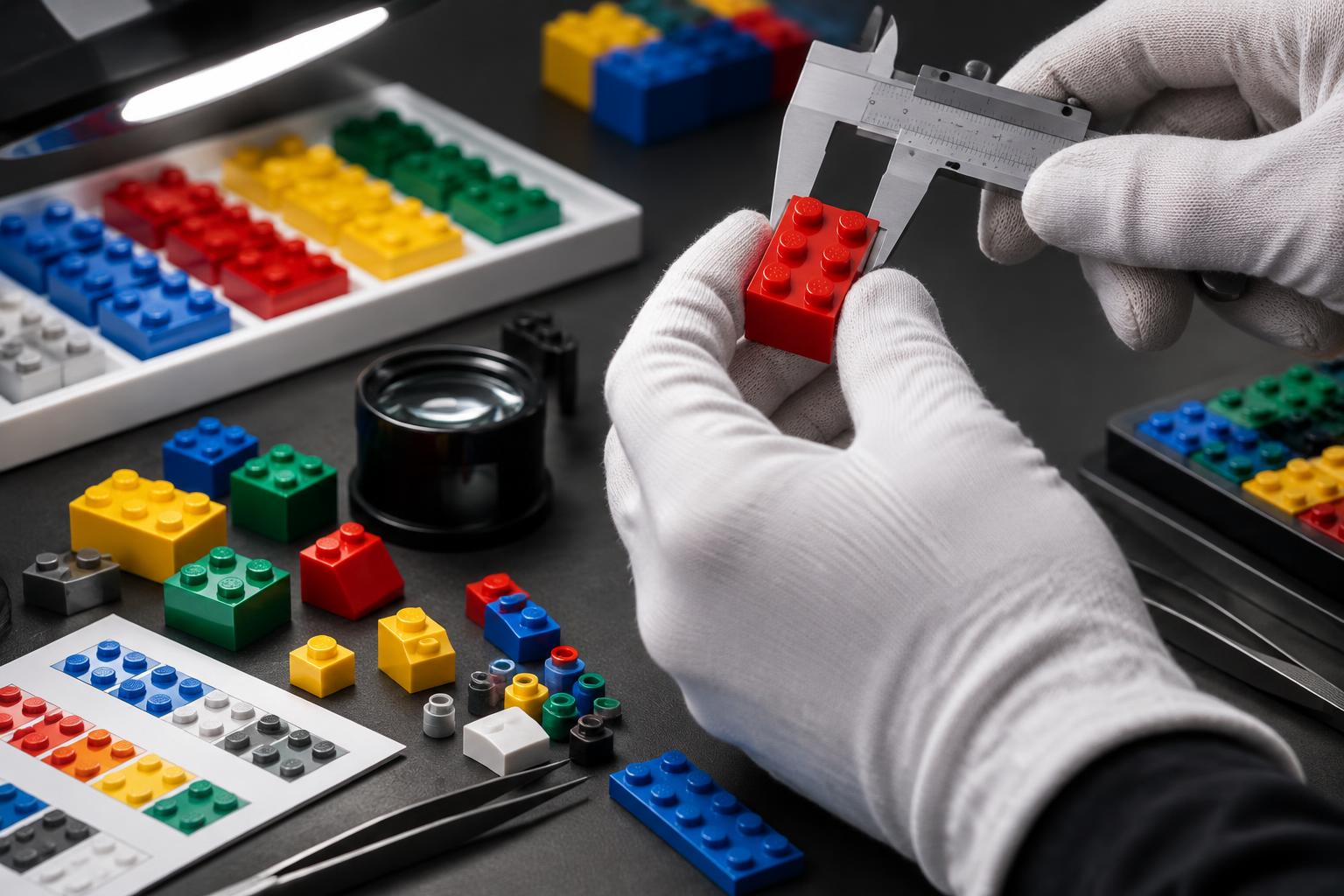
Run your fingers across the surface of a few bricks. It should feel smooth, with no visible mold lines, rough edges, or uneven texture. Poor surface finish often signals inconsistent manufacturing, which can also affect clutch power over time.
Printed and stickered elements deserve their own inspection:
- Print alignment: Printed details (faces, logos, dashboard panels) should sit centered and crisp, not smudged or off-register.
- Sticker quality: If the set uses stickers instead of printed pieces, check the adhesive quality and whether the designs align with the brick shape.
- Color saturation: Faded or overly glossy finishes can indicate lower-grade paint or print processes.
This matters more for collectors and display builders than for younger family users, since surface quality is what makes a finished model look good sitting on a shelf for years.
Step 4: Check Set Design, Instructions, and Build Experience
A strong compatible bricks treatment review also covers how the set builds, not just what it's made of. Instructions should be clear, step-by-step, and ideally available in English for US and European buyers without a confusing translation.
Look for:
- Logical build order: Steps should flow in a sequence that makes sense, without sudden jumps or missing sub-assemblies.
- Piece count accuracy: The box should match what's inside. Missing or extra pieces point to inconsistent quality control.
- Complexity rating: Sets should indicate difficulty level, especially useful for families choosing age-appropriate builds or adult collectors seeking a weekend-long challenge.
Community-shared build photos and video walkthroughs are useful here too. If you can browse full product listings before buying, do it — seeing real build photos from other owners tells you more than a glossy box render ever will.
Step 5: Compare Price-to-Value Ratio
Compatible bricks typically cost 40–70% less than official LEGO sets for comparable piece counts and complexity. But cheap isn't always better value. A compatible bricks treatment review should weigh price against piece count, plastic quality, print detail, and display appeal together, not price alone.
Ask these questions when comparing sets:
- Does the discount reflect genuine savings on manufacturing, or does it mean lower-grade materials?
- Is the piece count and model size actually comparable to a similarly priced official set?
- Does the brand offer any guarantee — missing piece replacement, returns, or customer support — that adds value beyond the sticker price?
For budget-conscious family buyers, this step often matters most. A $70 set that performs like a $150 official set is real value. A $30 set that falls apart after three builds is not.
Step 6: Review Community Feedback and Long-Term Durability
No individual review captures everything a set will do over months of handling. This is where community feedback fills the gap. Online builder communities, forums, and brand-run groups are where real owners report issues — stud wear, discoloration, broken clutch power — that don't show up in a first impression.
Check for:
- Repeat reviews mentioning the same issue (a consistent complaint is more telling than a single bad review)
- Photos of builds after months or years of display, not just fresh out of the box
- Brand responsiveness to reported problems, including replacement policies for missing or broken pieces
Active online communities also matter for creators and collectors specifically, since these spaces are where original designs, modifications, and display setups get shared and discussed.
Morebybourn — A Brand Worth Considering
MOREBYBOURN curates sets from manufacturers known for meeting ABS quality, clutch-power, and print-durability benchmarks — brands like Cada, Mould King, and Reobrix. Every set ships from a US warehouse with 3–5 day delivery and includes English instructions.
For US and European buyers running their own compatible bricks treatment review, MOREBYBOURN checks several boxes worth noting:
- Certified safety standards: Sets are manufactured to the same stud tolerance as official bricks, with safety certification appropriate for family buyers.
- Variety across use cases: Architecture, vehicles, space, and city collections cover adult collectors, creators, and family builders alike.
- Missing piece support: MOREBYBOURN commits to replacing missing or broken pieces free of charge — a detail that matters for anyone building large, complex sets.
- In-depth buying guides: The brand publishes comparison content so buyers can research before committing, rather than relying on product photos alone.
If you want a closer look at how this plays out across different set types, this comparison guide breaks down red flags to watch for across brands.
For a side-by-side buying framework, continue with our compatible bricks comparison guide.
Final Verdict: Run the Review Before You Build
A thorough compatible bricks treatment review takes maybe twenty minutes — checking certification, testing clutch power, inspecting print quality, and reading a handful of community reviews. That twenty minutes is the difference between a set that becomes a weekend project you're proud of and one that ends up half-built in a drawer.
Whether you're building with your kids on a Saturday afternoon, working through a 3,000-piece display model solo, or designing your own custom build, the same six checkpoints apply: material safety, clutch power, surface finish, build experience, price-to-value, and durability feedback.
Start with a brand that makes the review easy. Explore MOREBYBOURN's current sets to see certified, tested options across architecture, space, city, and vehicle collections — then run your own review before adding to cart.
Frequently Asked Questions
What's the difference between a compatible bricks treatment review and a regular product review?
A standard product review often focuses on appearance and price. A compatible bricks treatment review specifically tests technical performance — clutch power, stud tolerance, material safety, and cross-brand compatibility — alongside standard factors like price and design.
Are compatible bricks actually safe for young children?
Reputable brands certified to ASTM F963 (US) or EN71 (EU) use the same BPA-free, phthalate-free ABS plastic as official LEGO bricks. Always check for certification labeling, and follow age recommendations, particularly for sets with small pieces or Technic components.
How much can I expect to save by buying compatible bricks instead of official sets?
Most premium compatible brands price sets 40–70% below comparable official LEGO sets, without sacrificing clutch strength or print quality when the brand meets proper manufacturing standards.
Can I mix compatible bricks with my existing official LEGO collection?
Yes, provided the compatible brand manufactures to a similar stud tolerance (around ±0.01 mm). Test this yourself by connecting a few bricks from both sources before committing to a full mixed build.
What should I do if pieces are missing from a compatible bricks set?
Check the brand's replacement policy before buying. Brands like MOREBYBOURN replace missing or broken pieces free of charge, which is worth confirming through their support page before you need it.
Order LEGO Alternatives From Morebybourn
We sell LEGO alternative sets and compatible bricks for adult collectors, families, and creative builders. Ready to order? Browse our available sets, contact our customer service team, or message us on WhatsApp and we will help you place your order.
Order LEGO-Compatible Sets from Morebybourn
We sell LEGO alternative sets and compatible bricks for families, hobbyists, and collectors. Contact our customer service team for personal recommendations and help placing your order.