How to Choose and Use Compatible Building Blocks and Base Plates
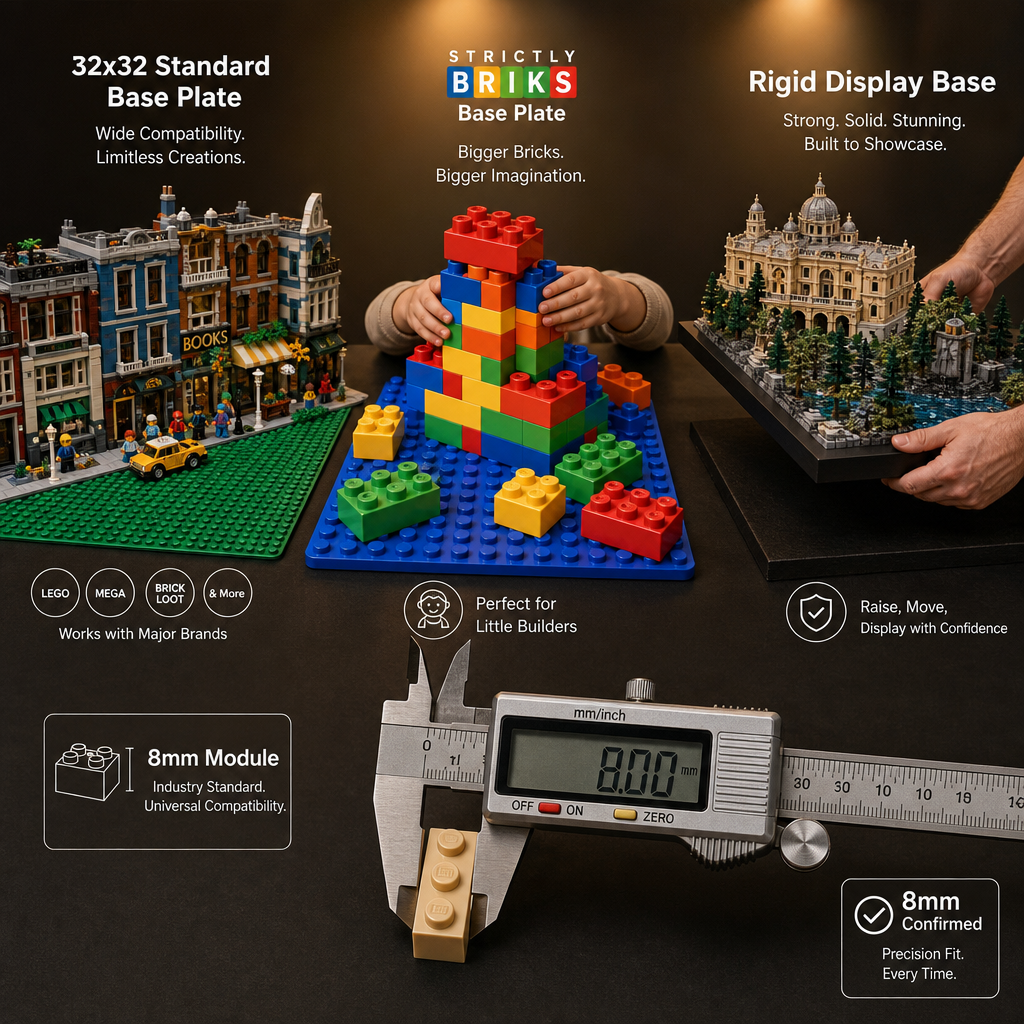
Building blocks are an open system. The studs on top and the tubes underneath follow a standard size, which means building blocks compatible with lego from different brands can connect. But "can connect" and "should connect" are not the same thing. Some blocks fit loosely. Some base plates warp. Some toddler sets do not lock with standard bricks at all.
This guide covers how compatibility actually works, how to pick the right lego compatible base plates, whether strictly briks compatible with lego duplo truly holds up, and how to set up builds for both toddlers and adult hobbyists — across North America and Europe.
Quick Answer
- Compatibility = stud spacing + clutch power + matching scale
- Strictly Briks connects to LEGO DUPLO (toddler scale) — not standard system
- Base plates: match scale first, then size, then flat vs rigid
- Mix brands with the 5-brick stack test before committing to structure
- Store base plates flat or upright — never under weight
How Brick Compatibility Actually Works
Most plastic building blocks share one core measurement. Standard bricks use a 5mm stud spacing and an 8mm module height. Building blocks compatible with lego match these numbers — which is why a Morebybourn brick clicks onto a set you already own.
But compatibility runs deeper than stud spacing. Clutch power and scale are equally important.
Stud Spacing
5mm / 8mm
The universal standard shared by all quality-grade compatible bricks. Confirms physical alignment across brands.
Clutch Power
Grip Test
The friction between stud and tube. Too loose = wobble. Too tight = small hands can't pull apart. Test before trusting.
Scale Match
Standard vs Toddler
Standard bricks and toddler bricks are two different systems. Never buy without confirming which scale your current collection uses.
Clutch Power Is the Real Test
Clutch power is the grip between a stud and the tube it slides into. Quality blocks hold firm but release with steady pressure. When testing a new brand:
- Press two bricks together — they should snap, not slide.
- Pull them apart — they should resist, then release cleanly.
- Stack five bricks — the column should stand without leaning.
Two Different Scales
Standard bricks and large toddler bricks are not the same size. Toddler blocks are roughly twice the dimensions of standard ones. Sets like strictly briks compatible with lego duplo are built to the larger toddler scale — so they connect with chunky early-learning bricks, not standard system pieces.
Reminder
Mixing scales by accident is the most common beginner mistake. Know which scale you need before you buy.
How to Choose the Right Base Plate
A base plate is the foundation. Every wobble, gap, and lean traces back to this single piece. Picking the right one matters more than any other early decision.
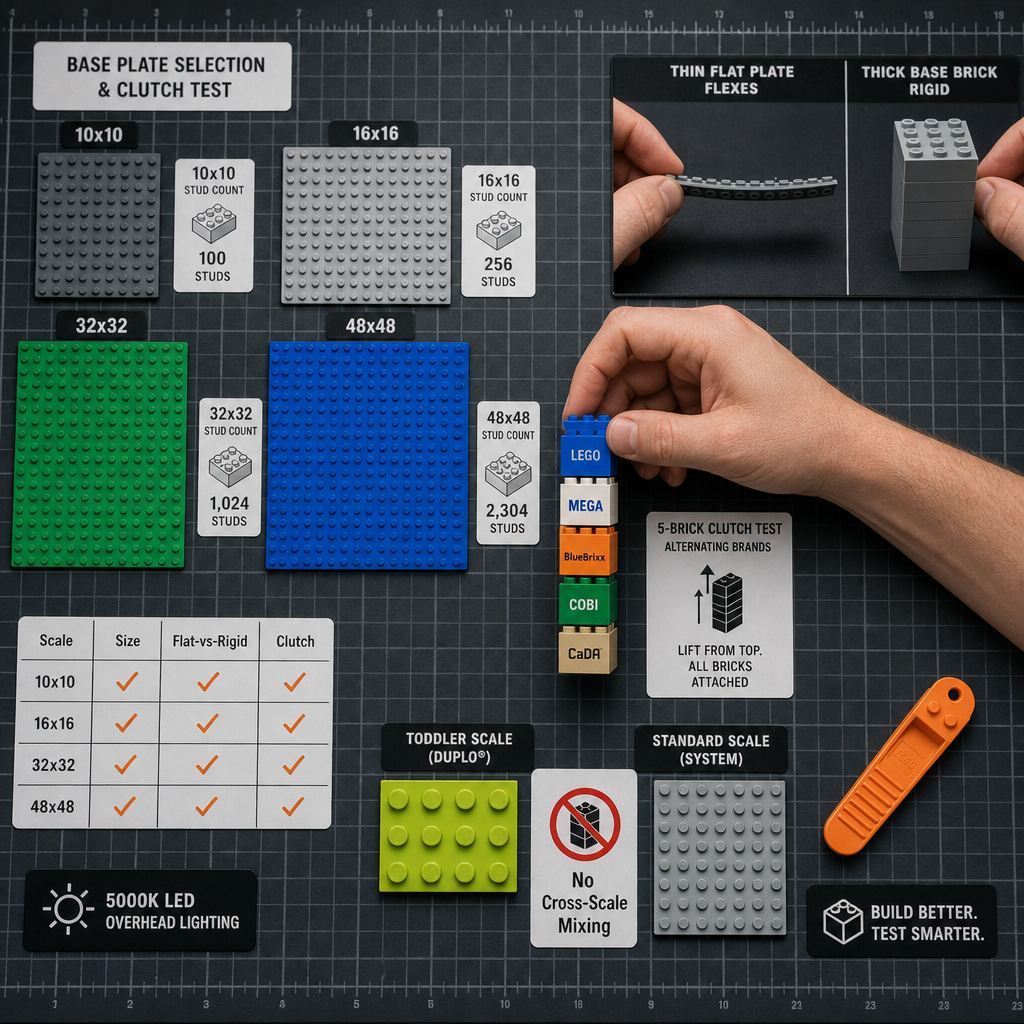
Base Plate Size Reference
| Size | Best For | Typical Use |
|---|---|---|
| 10×10 studs | Small builds | Single scenes, travel projects |
| 16×16 studs | Mid-size builds | Play setups, starter displays |
| 32×32 studs | General builds | Roads, buildings, dioramas |
| 48×48 studs | Large layouts | City layouts, classroom group builds |
Flat Plate or Brick-Style Base
Thin Flat Plate
Best for play surfaces- +Inexpensive
- +Ideal for table play
- +Easy to cover large areas
- −Flexes under weight
- −Not for moving builds
Thick Rigid Base Brick
Best for dioramas and display- +Carry finished builds safely
- +Display or transport ready
- +Resists warping
- −Higher cost
- −Heavier
Is Strictly Briks Compatible With LEGO DUPLO?
Yes — with one important condition. Strictly Briks is designed for the toddler scale, not the standard LEGO system. Its plates and bricks use the same large-stud spacing as LEGO DUPLO, which means strictly briks compatible with lego duplo is accurate for the toddler-scale product line.
Strictly Briks Compatibility Summary
- +Connects to LEGO DUPLO bricks
- −Connects to standard LEGO system bricks
- +Large-format base plates available
- +ABS plastic with safe clutch power
- +Sized for toddler hands (age 1.5+)
- +Works as cross-brand toddler connector
How to Mix Sets From Different Brands
Mixing brands multiplies your parts and your options. Done right, no one can tell where one brand ends and another begins. Done wrong, you get loose joints and color clashes. See the full testing workflow in our guide on finding and testing bricks compatible with LEGO.
Test Clutch Before You Commit
Run the 5-brick stack from above. If new bricks feel loose, use them for non-structural detail — not load-bearing walls.
Match Color Families
Group same-color pieces by brand on large surfaces. One brand's red may lean orange; another leans dark. Use shifts for texture on purpose.
Use Standard Bricks as Connectors
Plain 2×4 and 2×6 plates are the most reliable cross-brand connectors. Bridge sections from different sets with these pieces.
Never Force the Fit
Hard resistance signals a scale mismatch or defect. Forcing it cracks the brick or loosens its grip permanently. Set it aside.
Toddler Setups vs. Adult Builder Setups
Toddler Builds
- Use the toddler scale — chunky bricks, large studs
- Strictly Briks and DUPLO connect here
- Start with a large flat plate for stability
- Keep colors bold and limited
- Build low and wide — tall towers fall and frustrate
Adult / Hobbyist Builds
- Use standard scale for fine detail and complex techniques
- Choose rigid base bricks so finished models can be moved
- Plan your palette before building large surfaces
- Learn sideways building (SNOT) to hide studs
- See our set buyer's guide for curated recommendations
When parents and kids build together, mix scales by zone. Give the toddler a large-scale corner while adults work in standard scale nearby.
Storage and Organization That Saves Time
A great brick collection is useless if you cannot find the piece you need. Organization is the difference between an hour of building and an hour of searching.
By Color
Display workBest for builders who match palettes. Fast for large flat surface builds.
By Type
Technique buildsBricks, plates, tiles, slopes in separate bins. Best for MOC work.
By Set
FamiliesKeep each set bagged separately. Best for rebuilding from instructions.
Base Plate Storage Rule
Store lego compatible base plates flat or stand them upright in a slotted rack. Never pile heavy bins on top of thin plates — the weight bends them permanently.
Common Mistakes to Avoid
Mixing scales by accident
Always confirm standard vs toddler before buying.
Buying thin plates for builds you'll move
Use rigid bases for anything that travels or goes on display.
Ignoring clutch power
Run the stack test before trusting a brand with structural sections.
Overstacking base plates
Store them flat or upright — never under weight.
Skipping organization
A sorted collection builds faster and lasts longer.
Forcing a piece that resists
Hard resistance = scale mismatch or defect. Set it aside.
Key Takeaways
- Compatible building blocks share 5mm stud spacing and 8mm module height.
- Clutch power is the most important real-world compatibility factor.
- Strictly Briks connects to LEGO DUPLO (toddler scale) — not standard LEGO.
- Match scale first, then plate size, then flat vs rigid for base plates.
- Mix brands safely: test clutch, group colors by brand, use plain plates as connectors.
- Store base plates flat or upright — never under weight.
Related Guides
Ready to build with quality-compatible bricks?
Browse Morebybourn's full range of ABS standard-scale bricks, base plates, and accessories certified to ASTM F963 and EN71 standards.